Our Accreditations & Certifications
Every analytical method we run is held to the same standard required by federal regulators, courts, and the U.S. Department of Defense. AGT Labs maintains three independently verifiable ISO/IEC 17025 accreditations, two Texas licenses and CDC ELITE proficiency across industrial hygiene, environmental microbiology, asbestos, and mold analysis — with full scope details, certificate numbers, and verification links published below.
Continuously Accredited Since the Year 2000
Most labs add accreditations as they grow. Few maintain unbroken accreditation for over two decades. AGT Labs has held continuous AIHA-LAP accreditation since February 1, 2000 — across every annual proficiency round, every on-site assessment, and every revision of ISO/IEC 17025.
Accreditation Summary
All certificate numbers, scopes, and expiration dates at a glance. Click any accreditation in the table to jump to its full method scope below.
| Accreditation Body | Identifier | Scope | Issued / Expires | Certificate | Status |
|---|---|---|---|---|---|
|
AIHA-LAP, LLC
Industrial Hygiene + Environmental Microbiology
|
LAP-101470 | ISO/IEC 17025:2017 — IHLAP & EMLAP 117 methods across 12 platforms |
Issued 09/30/2026 Expires 01/01/2027 |
View PDF | Active |
|
NVLAP / NIST
National Voluntary Laboratory Accreditation Program
|
101793-0 | ISO/IEC 17025:2017 — Asbestos Fiber Analysis EPA 40 CFR Part 763 & EPA 600/R-93/116 |
Effective 01/01/2026 Expires 12/31/2026 |
View PDF | Active |
|
PJLA
Perry Johnson Laboratory Accreditation, Inc.
|
137751 | ISO/IEC 17025:2017 — Environmental Testing Asbestos PLM (solid) & PCM (air) |
Issued 08/13/2026 Expires 11/30/2028 |
View PDF | Active |
|
Texas DSHS
Department of State Health Services
|
300529 | Asbestos Laboratory License — PCM, PLM TX Occupations Code Ch. 1954 / TX Admin. Code Ch. 295 |
— Expires 08/18/2027 |
View License | Active |
|
Texas TDLR
Department of Licensing and Regulation
|
LAB1070 | Mold Analysis Laboratory License Mold analysis laboratory license |
— Expires 11/13/2027 |
View PDF | Active |
| CDC ELITE Program | Legionella Culture | CDC ELITE proficiency — Legionella culture (environmental samples) | Issued 08/06/2026 Expires 12/01/2027 |
View PDF | Active |
AIHA Laboratory Accreditation Programs (AIHA-LAP)
Our broadest scope. AIHA-LAP, LLC accredits laboratories under the ISO/IEC 17025:2017 international standard for the technical competence of testing laboratories. AGT Labs has held continuous AIHA-LAP accreditation since February 1, 2000.
AIHA-LAP IHLAP & EMLAP — 117 Accredited Methods Across 12 Platforms
AIHA-LAP, LLC operates two of the most rigorous laboratory accreditation programs for occupational health analysis in the United States — the Industrial Hygiene Laboratory Accreditation Program (IHLAP) for chemistry-based exposure analysis, and the Environmental Microbiology Laboratory Accreditation Program (EMLAP) for fungal, bacterial, and bioaerosol analysis. AGT Labs holds active accreditation under both programs.
The IHLAP scope alone covers 117 individual analytical method entries spanning 12 instrumental platforms — making it one of the broadest industrial hygiene accreditation scopes among independent U.S. testing laboratories. Continued accreditation requires successful on-site assessments, ongoing proficiency testing, and demonstrated quality system performance.
What This Means For You
If you're submitting industrial hygiene exposure data to OSHA, NIOSH, or in litigation — your results carry the same evidentiary weight regardless of which method we run. This single accreditation covers nearly every regulated airborne contaminant: solvents, metals, silica, mercury, PCBs, aldehydes (formaldehyde and glutaraldehyde), ammonia, asbestos in air, and more.
Programs Held
Industrial Hygiene
Environmental Microbiology
Accreditation Standard
ISO/IEC 17025:2017
Total Scope
117 methods · 12 platforms
Accredited Analytical Platforms & Methods
Total: 117 method entries across 12 analytical platforms (per AIHA-LAP scope, Issue Date 05/06/2025). Below, method and method-modified pairs are shown together for readability.
| Method | Analyte / Component | Reference Body |
|---|---|---|
Gas Chromatography — FID Detector Hydrocarbons, alcohols, amines, aldehydes, BTEX, organic acids, glycols, phthalates | ||
| NIOSH 1001 / 1001 Mod | Methyl Chloride | NIOSH |
| NIOSH 1003 / 1003 Mod | Hydrocarbons | NIOSH |
| NIOSH 1005 / 1005 Mod | Hydrocarbons | NIOSH |
| NIOSH 1007 / 1007 Mod | Hydrocarbons | NIOSH |
| NIOSH 1010 / 1010 Mod | Hydrocarbons | NIOSH |
| NIOSH 1015 / 1015 Mod | Hydrocarbons | NIOSH |
| NIOSH 1022 / 1022 Mod | Hydrocarbons | NIOSH |
| NIOSH 1024 | Hydrocarbons | NIOSH |
| NIOSH 1300 / 1300 Mod | Hydrocarbons | NIOSH |
| NIOSH 1301 / 1301 Mod | Hydrocarbons | NIOSH |
| NIOSH 1400 / 1400 Mod | Hydrocarbons | NIOSH |
| NIOSH 1401 / 1401 Mod | Alcohols | NIOSH |
| NIOSH 1402 / 1402 Mod | Hydrocarbons | NIOSH |
| NIOSH 1403 / 1403 Mod | Hydrocarbons | NIOSH |
| NIOSH 1450 | Hydrocarbons | NIOSH |
| NIOSH 1452 / 1452 Mod | Hydrocarbons | NIOSH |
| NIOSH 1453 / 1453 Mod | Hydrocarbons | NIOSH |
| NIOSH 1454 / 1454 Mod | Hydrocarbons | NIOSH |
| NIOSH 1457 / 1457 Mod | Hydrocarbons | NIOSH |
| NIOSH 1458 / 1458 Mod | Hydrocarbons | NIOSH |
| NIOSH 1500 / 1500 Mod | Hydrocarbons | NIOSH |
| NIOSH 1501 / 1501 Mod | Hydrocarbons (BTEX, aromatic) | NIOSH |
| NIOSH 1550 | Hydrocarbons | NIOSH |
| NIOSH 1552 | Hydrocarbons | NIOSH |
| NIOSH 1603 | Organic Acids | NIOSH |
| NIOSH 1604 / 1604 Mod | Acrylonitrile | NIOSH |
| NIOSH 1606 / 1606 Mod | Hydrocarbons | NIOSH |
| NIOSH 1609 / 1609 Mod | Hydrocarbons | NIOSH |
| NIOSH 1610 / 1610 Mod | Hydrocarbons | NIOSH |
| NIOSH 1611 | Hydrocarbons | NIOSH |
| NIOSH 1612 / 1612 Mod | Propylene Oxide | NIOSH |
| NIOSH 1613 / 1613 Mod | Hydrocarbons | NIOSH |
| NIOSH 1614 Mod | Hydrocarbons | NIOSH |
| NIOSH 1615 / 1615 Mod | Hydrocarbons | NIOSH |
| NIOSH 2000 | Hydrocarbons | NIOSH |
| NIOSH 2002 | Amines | NIOSH |
| NIOSH 2012 | Amines | NIOSH |
| NIOSH 2500 | Hydrocarbons | NIOSH |
| NIOSH 2537 | Hydrocarbons | NIOSH |
| NIOSH 2539 | Aldehydes — 12-analyte screening (2-HMP/XAD-2) | NIOSH |
| NIOSH 2541 | Aldehydes — formaldehyde by GC (2-HMP/XAD-2) | NIOSH |
| NIOSH 2546 | Cresol & Phenol | NIOSH |
| NIOSH 2553 | Hydrocarbons | NIOSH |
| NIOSH 2562 / 2562 Mod | Hydrocarbons | NIOSH |
| NIOSH 5020 | Phthalates | NIOSH |
| NIOSH 5523 | Glycols | NIOSH |
| OSHA 1002 | Xylenes | OSHA |
| OSHA 1005 | Benzene | OSHA |
| OSHA 111 | Toluene | OSHA |
| OSHA 19 / 19 Mod | Hydrocarbons | OSHA |
| OSHA 4000 | Toluene | OSHA |
| OSHA 72 | Furfural | OSHA |
Gas Chromatography — Mass Spectrometry (GC/MS) Volatile hydrocarbons via Summa canister and thermal desorption tubes | ||
| EPA 325B | Volatile Hydrocarbons | EPA |
| EPA TO-15 | Volatile Hydrocarbons (Summa canister VOCs) | EPA |
Gas Chromatography — ECD & Diffusive Sampler PCB analysis & passive badge sampling for organic hydrocarbons | ||
| NIOSH 5503 | Polychlorinated Biphenyls (PCBs) — GC/ECD | NIOSH |
| In-house | Organic Hydrocarbons in Badges (Diffusive Sampler / GC) | AGT Labs |
Ion Chromatography (IC) Inorganic acids, ozone, hexavalent chromium, sulfur dioxide, halogens | ||
| NIOSH 6004 | Sulfur Dioxide (SO₂) | NIOSH |
| NIOSH 6011 | Chlorine & Bromine | NIOSH |
| NIOSH 7906 | Inorganic Acids | NIOSH |
| NIOSH 7907 | Inorganic Acids | NIOSH |
| NIOSH 7908 | Inorganic Acids | NIOSH |
| OSHA 214 | Ozone (O₃) | OSHA |
| OSHA ID-165SG | Inorganic Acids | OSHA |
| OSHA ID-186SG | Organic Acids | OSHA |
| OSHA ID-215 (v2) | Hexavalent Chromium (Cr VI) | OSHA |
| OSHA PV2119 | Acetic Acid | OSHA |
High-Performance Liquid Chromatography (HPLC) Diisocyanates, aldehydes (formaldehyde, glutaraldehyde, carbonyls), PAHs — UV & Fluorescence detection | ||
| OSHA 42 | Diisocyanates (TDI, MDI, HDI) — HPLC/FL | OSHA |
| OSHA 42 | Diisocyanates — HPLC/UV | OSHA |
| EPA TO-11 | Aldehydes — carbonyl compound speciation, DNPH cartridge — HPLC/UV | EPA |
| NIOSH 2016 | Aldehydes — formaldehyde, DNPH cartridge (active sampling) — HPLC/UV | NIOSH |
| NIOSH 5506 | Polynuclear Aromatic Hydrocarbons (PAHs) — HPLC/UV | NIOSH |
| OSHA 1007 | Formaldehyde — diffusive (passive) samplers — HPLC/UV | OSHA |
| OSHA 64 | Aldehydes — glutaraldehyde, DNPH-treated filter — HPLC/UV | OSHA |
Inductively Coupled Plasma — Atomic Emission (ICP/AES) Multi-element metals analysis in air, surface wipes, and bulk media | ||
| NIOSH 7300 Modified | Metals (Multi-element) | NIOSH |
| NIOSH 7303 | Metals (Multi-element) | NIOSH |
| NIOSH 9100 | Metals (Wipe samples) | NIOSH |
| OSHA 125G Modified | Metals | OSHA |
X-Ray Diffraction (XRD) Crystalline silica (quartz, cristobalite) per OSHA 1910.1053 | ||
| NIOSH 7500 | Silica, Crystalline (Quartz) | NIOSH |
| NIOSH 7500 | Cristobalite | NIOSH |
| OSHA ID-142 (v4) | Silica, Crystalline (Quartz) | OSHA |
| OSHA ID-142 (v4) | Cristobalite | OSHA |
Cold Vapor Atomic Absorption (CVAA) Mercury vapor — chlor-alkali, dental, lamp recycling | ||
| NIOSH 6009 | Mercury | NIOSH |
| OSHA ID-140 | Mercury | OSHA |
| OSHA ID-145 | Mercury | OSHA |
Gravimetric Analysis Total & respirable dust — particulate mass determination | ||
| NIOSH 0500 | Total Dust | NIOSH |
| NIOSH 0600 | Respirable Dust | NIOSH |
UV/VIS Spectrophotometry (Colorimetric) Ammonia and other absorbance-based analytes | ||
| NIOSH 6015 | Ammonia (NH₃) | NIOSH |
Phase Contrast Microscopy (PCM) Airborne fiber counting — asbestos worker exposure monitoring | ||
| NIOSH 7400 | Asbestos / Fibers | NIOSH |
Note: Full method scope, revision dates, and field-of-testing categories are detailed in the official AIHA-LAP Scope of Accreditation document. Method codes and platform classifications shown here mirror the IHLAP scope categories (Asbestos/Fiber Microscopy Core, Chromatography Core, Spectrometry Core, Miscellaneous Core). Aldehyde analysis spans two platforms on this scope — HPLC/UV (NIOSH 2016, OSHA 1007, OSHA 64, EPA TO-11) and GC/FID (NIOSH 2539, NIOSH 2541, OSHA 72). See Aldehyde Testing for how each method is applied.
NVLAP — National Voluntary Laboratory Accreditation Program
Administered by the National Institute of Standards and Technology (NIST) under the U.S. Department of Commerce. NVLAP is the recognized accreditation program for asbestos fiber analysis in bulk building materials and is required for many federal and state asbestos abatement projects.
Bulk Asbestos Analysis — NVLAP Lab Code 101793-0
NVLAP accreditation is the gold-standard credential for asbestos bulk material analysis in the United States. Issued under ISO/IEC 17025:2017, NVLAP accreditation demonstrates that a laboratory has met the technical competence requirements established by NIST through proficiency testing, documented quality systems, and on-site assessment.
Most state asbestos programs and federal renovation/demolition projects under EPA AHERA and NESHAP require analysis by an NVLAP-accredited laboratory. AGT Labs has held continuous NVLAP accreditation for asbestos fiber analysis under Lab Code 101793-0.
What This Means For You
If you're an AHERA-certified inspector, demolition contractor, school district, or property owner — NVLAP is the credential federal and most state regulators specifically require for asbestos PLM bulk analysis. Reports issued under Lab Code 101793-0 are accepted nationwide for AHERA, NESHAP, OSHA 1926.1101, and HUD lead/asbestos projects.
Lab Code
101793-0
Accreditation Type
Asbestos Fiber Analysis (Bulk)
International Status
ILAC-MRA Recognized
Bulk Asbestos Analysis — Accredited Methods
| Code | Method Reference | Description | Matrix |
|---|---|---|---|
| 18/A01 | EPA 40 CFR Appendix E to Subpart E of Part 763 | Interim Method for the Determination of Asbestos in Bulk Insulation Samples | Bulk Insulation |
| 18/A03 | EPA 600/R-93/116 | Method for the Determination of Asbestos in Bulk Building Materials | Bulk Building Materials |
Both methods are performed by Polarized Light Microscopy (PLM) with dispersion staining, the EPA-recognized technique for identifying and quantifying asbestos in solid building materials. Used for pre-renovation surveys, AHERA inspections, and state-mandated abatement clearance work.
PJLA — Environmental Testing Accreditation
Issued by Perry Johnson Laboratory Accreditation, Inc. (PJLA), an ILAC-MRA signatory accreditation body. This is our third independent ISO/IEC 17025:2017 accreditation, held in the field of Environmental Testing and covering asbestos analysis by both PLM and PCM.
Environmental Testing — Asbestos PLM & PCM Scope
Perry Johnson Laboratory Accreditation, Inc. (PJLA) is an independent, internationally recognized accreditation body and a signatory to the ILAC Mutual Recognition Arrangement. PJLA has assessed AGT Labs against ISO/IEC 17025:2017 — the general requirements for the competence of testing and calibration laboratories — and confirmed technical competence in the field of Environmental Testing.
The current certificate, No. L26-747 under Accreditation No. 137751, was issued August 13, 2026 and runs through November 30, 2028. Its scope supplement covers asbestos in solid materials by EPA 600/R-93/116 (PLM) and asbestos in air by NIOSH 7400 (PCM). Validity is maintained through ongoing assessment on a continuous accreditation cycle and is confirmable directly at pjlabs.com.
What This Means For You
Your asbestos data is covered by two independent ISO/IEC 17025:2017 accreditations — NVLAP and PJLA — plus a Texas DSHS state licence. If a client, insurer, or reviewing agency questions one accreditation, a second independent body has assessed the same methods against the same international standard. Very few asbestos laboratories can say that.
Accreditation Body
PJLA (Perry Johnson Laboratory Accreditation, Inc.)
Standard
ISO/IEC 17025:2017
Field Of Testing
Environmental Testing
(Asbestos PLM & PCM)
PJLA Accredited Methods — Scope Supplement
| Method | Technique | Analyte | Matrix | TNI Code |
|---|---|---|---|---|
| EPA 600/R-93/116 | Polarized Light Microscopy (PLM) | Asbestos (TNI 1520) | Solid | 10294583 |
| NIOSH 7400 | Phase Contrast Microscopy (PCM) | Asbestos (TNI 1520) | Air | 90018001 |
Method codes are based on The NELAC Institute (TNI) Laboratory Accreditation Management System (LAMS) and represent the method/technology used to report proficiency test results. Scope supplement issued 8/13/2026 in conjunction with certificate #L26-747. The validity of this certificate is maintained through ongoing assessments on a continuous accreditation cycle.
Texas Asbestos Laboratory License (DSHS)
Issued by the Texas Department of State Health Services under the Texas Asbestos Health Protection Rules. Required for any laboratory analyzing asbestos samples connected to Texas building renovation, demolition, or abatement projects.
Texas Asbestos Laboratory — License No. 300529
This license certifies AGT LABS INC DBA AGT LABS as an authorized Asbestos Laboratory in the State of Texas, governed by the rights, privileges, and responsibilities set forth in Texas Occupations Code, Chapter 1954 and Title 12, Texas Administrative Code, Chapter 295 relating to Texas Asbestos Health Protection.
Texas requires that any asbestos sample collected from a project under state jurisdiction be analyzed by a DSHS-licensed laboratory. This license covers both Polarized Light Microscopy (PLM) for bulk material analysis and Phase Contrast Microscopy (PCM) for airborne fiber counting.
What This Means For You
If your asbestos project is anywhere in Texas — a Houston demolition, a Dallas school renovation, an Austin commercial retrofit — Texas state law requires that your bulk PLM and air PCM samples be analyzed by a DSHS-licensed laboratory. Out-of-state labs without this license cannot legally produce data for Texas asbestos abatement projects.
License Type
Asbestos Laboratory
(PCM & PLM)
Issuing Authority
Texas DSHS
Commissioner of Health
Regulatory Code
TX Admin. Code Title 12, Ch. 295
License Coverage
| Method | Description | Matrix | Typical Use Case |
|---|---|---|---|
| PLM | Polarized Light Microscopy | Bulk Materials | Pre-renovation building material identification |
| PCM | Phase Contrast Microscopy | Air | Airborne fiber counting during & after abatement |
License is non-transferable and void if altered. Validity is contingent on the license not being suspended or revoked.
Texas Mold Analysis Laboratory License (TDLR)
Issued by the Texas Department of Licensing and Regulation. Required to perform analytical mold testing on samples collected by Texas-licensed Mold Assessors and Mold Remediation Contractors under the Texas Mold Assessment and Remediation Rules.
Mold Analysis Laboratory — License LAB1070
The Texas Department of Licensing and Regulation (TDLR) administers Texas's mold assessment and remediation program. Texas law requires that mold samples connected to indoor environmental investigations, water-damage claims, and remediation clearance projects be analyzed by a TDLR-licensed Mold Analysis Laboratory. AGT Labs holds active license LAB1070, valid through November 13, 2027.
This state license complements our AIHA-LAP EMLAP accreditation for environmental microbiology, giving Texas clients a single laboratory that satisfies both state regulatory requirements and ISO/IEC 17025:2017 quality standards on every mold sample.
What This Means For You
If you're a TDLR-licensed Mold Assessment Consultant or Remediation Contractor, an insurance adjuster handling water-damage claims, or a Texas property owner — your mold tape lifts, swabs, bulk samples, and air-O-cell cassettes must be analyzed by a TDLR-licensed lab to produce results valid for Texas Mold Assessment Reports and Mold Remediation Protocols.
License Type
Mold Analysis Laboratory
Issuing Authority
TDLR — Executive Director
Pairs With
AIHA-LAP EMLAP
(LAP-101470)
Mold Analysis Methods Covered
| Method Type | Description | Sample Format | Turnaround |
|---|---|---|---|
| Spore Trap | Direct microscopic identification & counting of airborne fungal spores | Air-O-Cell, Allergenco, Micro5, Bio-SIS | Standard 5 business days · Rush 1–4 days |
| Direct Microscopy | Visual fungal identification on tape lifts & surface lifts | Bio-Tape, swab, lift slide | Standard 5 business days · Rush 1–4 days |
| Bulk Mold | Direct exam of suspected materials | Drywall, wood, fabric, dust | Standard 5 business days · Rush 1–4 days |
Mold analysis turnaround surcharges follow our standard rush schedule (1-day +100%, 2-day +75%, 3-day +50%, 4-day +25%).
CDC ELITE — Legionella Culture
AGT Labs is enrolled in the CDC Environmental Legionella Isolation Techniques Evaluation (ELITE) Program for culture-based detection of Legionella in environmental samples.
CDC ELITE Legionella Culture Certificate
External proficiency evaluation for laboratories performing Legionella culture, supporting reliable results for water-management and public-health investigations.

What Accreditation Actually Means For Your Project
Anyone can call themselves a "lab." Accreditation is what separates a private testing operation from one whose results are accepted by OSHA, the EPA, the courts, and the U.S. military.
Defensible In Court
ISO/IEC 17025:2017 accredited results carry evidentiary weight in OSHA enforcement actions, workers' compensation claims, indoor air quality litigation, and asbestos liability cases. Non-accredited results often don't.
Continuous Oversight
Accreditation isn't a one-time stamp. It requires ongoing on-site assessments, blind proficiency testing rounds, internal audits, and method validations — every year, on every accredited method.
International Recognition
NVLAP, AIHA-LAP, and PJLA are all signatories to the ILAC Mutual Recognition Arrangement. Our reports are accepted in over 100 countries — useful for global manufacturers, multinational employers, and export compliance.
Dual-Accredited Asbestos
Our asbestos PLM and PCM methods are accredited to ISO/IEC 17025:2017 by two independent bodies — NVLAP and PJLA — and separately licensed by Texas DSHS. Redundant oversight on the analysis regulators scrutinise most.
Method Traceability
Every accredited method is traceable to its published reference (NIOSH, OSHA, EPA, AHERA). Your final report cites the exact method version run, so your consultants and regulators know exactly what was measured and how.
Multiple Independent Bodies
Three different accreditation bodies (NVLAP, AIHA-LAP, PJLA) plus two state regulators — each independently auditing different aspects of our quality system. No single point of failure in oversight.
What Holds The Accreditation Up
An accreditation certificate is the visible proof. The real work happens daily — in personnel competence, proficiency testing, internal QC, and chain-of-custody discipline. ISO/IEC 17025:2017 doesn't just require a quality manual; it requires that each of these be demonstrably operating on every sample we run.
Personnel Competence
ISO 17025 §6.2 requires documented competence for every analyst on every accredited method. Our staff competence file includes:
- Initial demonstration of capability (IDOC) on each method before unsupervised work
- Continued demonstration of capability via blind QC samples
- NIOSH 582 training for all PCM (asbestos air) analysts
- NVLAP-required training for PLM bulk asbestos analysts
- Documented role-specific training for microbiology, IC, GC/MS, and ICP analysts
Proficiency Testing (PT)
Each accredited method is verified by blind, third-party-administered proficiency testing rounds — every year, on every method, without exception:
- AIHA-PAT rounds for Industrial Hygiene chemistry methods
- AIHA-EMPAT rounds for Environmental Microbiology methods
- NIST NVLAP proficiency rounds for asbestos PLM bulk analysis
- PJLA proficiency test requirements for the ISO/IEC 17025 environmental testing scope
- Failed-round corrective action documented and audited per ISO 17025 §7.7
Internal Quality Controls
Every analytical batch carries the QC controls required to validate the result before it leaves the lab — not a sampling, every run:
- Method blanks to verify the system is contamination-free
- Laboratory Control Samples (LCS) to verify accuracy at known concentrations
- Matrix spikes & matrix spike duplicates (MS/MSD) for recovery and precision
- Calibration verification standards bracketing every analytical run
- Initial & continuing calibrations meeting method-specific %R and RSD criteria
Chain of Custody & Traceability
Defensible data starts before the sample arrives. Our COC and sample-handling protocol satisfies OSHA, EPA, AHERA, and DoD evidentiary requirements:
- Unique laboratory ID assigned at receipt; original COC document retained
- Sample condition, temperature, and integrity verified and recorded
- Every transfer of custody (receipt → prep → analysis → archive) signed and dated
- Reference standards and reagents traceable to NIST or certified suppliers
- Sample retention and disposal logged per regulatory and client retention rules
How To Independently Verify Each Accreditation
We publish our certificate numbers and the public verification source for every accreditation. You don't have to take our word for any of it.
NVLAP — NIST
Lab Code 101793-0Search the NIST NVLAP directory for active Asbestos Fiber Analysis labs. Confirm Lab Code 101793-0 with current effective dates.
Verify at nist.gov/nvlapAIHA-LAP, LLC
Lab ID LAP-101470Use the AIHA Accredited Labs directory to confirm IHLAP and EMLAP scopes, expiration dates, and active status.
Verify at aihaaccreditedlabs.orgPJLA
Accreditation No. 137751Search the PJLA accredited labs directory. Certificate L26-747, valid through November 30, 2028.
Verify at pjlabs.comTexas DSHS Asbestos
License No. 300529Search the TX DSHS Asbestos Programs licensee directory by license number. Expires August 18, 2027.
Verify at dshs.texas.govTexas TDLR Mold
License LAB1070Search the TDLR public license search for Mold Analysis Laboratory LAB1070. Expires November 13, 2027.
Verify at tdlr.texas.govNeed Something Specific?
Direct ContactIf you need scope letters, certificate copies for a specific bid package, or method-specific accreditation confirmation, our QA team can email documentation the same business day.
Email qa@agtlabs.comAccreditation FAQ
What is ISO/IEC 17025:2017 and why does it matter?
ISO/IEC 17025:2017 is the international standard for the technical competence of testing and calibration laboratories. Accreditation under this standard is granted only after rigorous, on-site assessment of a lab's quality management system, equipment, methods, personnel competence, and proficiency testing performance.
AGT Labs holds ISO/IEC 17025:2017 accreditation under three independent bodies — AIHA-LAP, NVLAP, and PJLA.
How do I independently verify all of these accreditations?
All credentials are publicly verifiable:
• NVLAP Lab Code 101793-0 → nist.gov/nvlap
• AIHA-LAP Lab ID LAP-101470 → aihaaccreditedlabs.org
• PJLA Accreditation No. 137751 → pjlabs.com
• Texas DSHS Asbestos License 300529 → dshs.texas.gov
• Texas TDLR Mold License LAB1070 → tdlr.texas.gov
What does the PJLA accreditation actually cover?
Perry Johnson Laboratory Accreditation, Inc. (PJLA) is an independent ISO/IEC 17025 accreditation body and an ILAC-MRA signatory. It has assessed AGT Labs and confirmed technical competence in the field of Environmental Testing.
AGT Labs holds PJLA Accreditation No. 137751 under Certificate No. L26-747, valid through November 30, 2028 — covering asbestos in solid materials by EPA 600/R-93/116 (PLM) and asbestos in air by NIOSH 7400 (PCM).
What is the difference between NVLAP and AIHA-LAP?
Both are ISO/IEC 17025:2017 accreditation programs, but they cover different scopes.
NVLAP (administered by NIST under the U.S. Department of Commerce) is the recognized accreditation for asbestos fiber analysis in bulk building materials. AIHA-LAP (administered by AIHA Laboratory Accreditation Programs, LLC) accredits laboratories for industrial hygiene chemistry methods (IHLAP) and environmental microbiology (EMLAP).
AGT Labs holds both — NVLAP Lab Code 101793-0 and AIHA-LAP Lab ID LAP-101470.
Are your reports accepted for OSHA enforcement & legal cases?
Yes. ISO/IEC 17025:2017 accredited results are accepted by OSHA, EPA, the Department of Defense, state regulatory agencies, and courts of law as defensible analytical data.
Our accreditations are recognized internationally through the ILAC Mutual Recognition Arrangement (ILAC-MRA), meaning our reports are accepted by signatory countries worldwide.
How many analytical methods does AGT Labs hold accreditation for?
AGT Labs maintains AIHA-LAP IHLAP accreditation for 117 individual industrial hygiene method entries spanning 12 analytical platforms — including GC/FID, GC/MS, GC/ECD, HPLC, Ion Chromatography, ICP/AES, XRD, CVAA, gravimetric, UV/VIS, and PCM.
Our scope is among the broadest IHLAP scopes among U.S. industrial hygiene testing laboratories. The full list of accredited methods is published in the AIHA-LAP section above.
Which aldehyde methods are on your accredited scope?
Aldehyde analysis sits on two platforms of our AIHA-LAP scope. By HPLC/UV: NIOSH 2016 (formaldehyde, active DNPH cartridge), OSHA 1007 (formaldehyde, diffusive samplers), OSHA 64 (glutaraldehyde) and EPA TO-11 (carbonyl speciation). By GC/FID: NIOSH 2541 (formaldehyde), NIOSH 2539 (12-analyte aldehyde screening) and OSHA 72 (furfural).
Method selection depends on the analyte and whether you need quantitation or screening — see Aldehyde Testing.
How often are accreditations renewed?
NVLAP renews annually. AIHA-LAP operates on a 2-year cycle with annual surveillance. PJLA runs a continuous accreditation cycle with periodic on-site assessments. Texas DSHS asbestos licenses run 2 years; Texas TDLR mold licenses run 2 years.
Between renewals, accredited labs are continuously evaluated through proficiency testing rounds, internal audits, and method-by-method quality control performance.
Can you supply a scope letter for a specific bid package?
Yes. Our QA team supplies project-specific scope letters, certificate copies, and method confirmation documents the same business day. Email qa@agtlabs.com with your project requirements (specific methods, agency requirements, contract reference number) and we'll respond with the documentation you need.
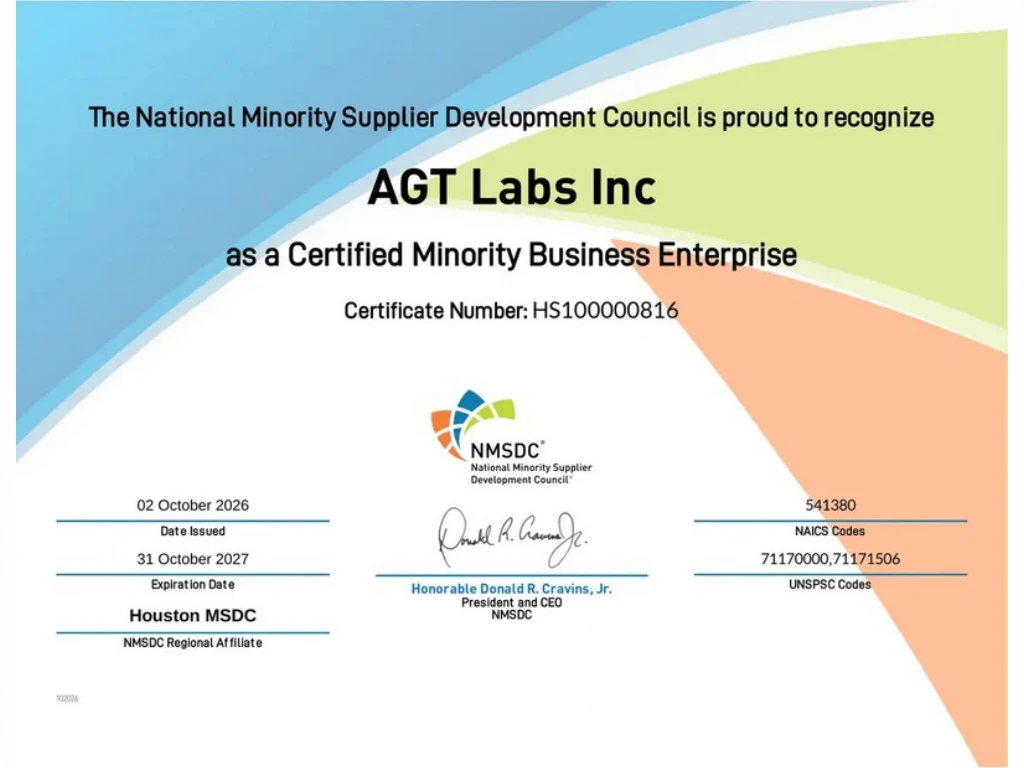
NMSDC Minority Business Enterprise Certification
AGT Labs is a certified Minority Business Enterprise (MBE) through the National Minority Supplier Development Council, Houston MSDC regional affiliate.