
Hexavalent Chromium Testing Lab Houston, TX — OSHA ID-215
AIHA IHLAP-accredited industrial hygiene testing laboratory for hexavalent chromium Cr(VI) speciation at 10200 East Freeway, Houston TX 77029. OSHA ID-215 (v2) IC on Na₂CO₃-impregnated filters — refrigerated chain of custody required. OSHA 1910.1026 action level (2.5 µg/m³) and PEL (5 µg/m³) compliance. Cr(VI) wipe sampling and bulk coating analysis. AIHA IHLAP LAP-101470 and ISO/IEC 17025:2017 accredited — continuous AIHA accreditation since 2000. Samples received before 2:00 PM CST logged same day.
Hexavalent chromium is an IARC Group 1 confirmed human carcinogen — it causes lung cancer with no known safe exposure threshold, and OSHA 1910.1026 is strictly enforced
IARC Group 1 — Confirmed Human Carcinogen
Cr(VI) compounds are classified as IARC Group 1. Epidemiological studies of chrome platers and stainless steel welders demonstrate significantly elevated lung cancer mortality at occupational exposure levels. Hexavalent chromium testing quantifies this specific risk.
NIOSH REL Is 25× More Protective Than OSHA PEL
OSHA's PEL is 5 µg/m³. NIOSH REL is 0.2 µg/m³ — 25× more protective. This gap exists because OSHA's PEL was set using economic and feasibility constraints, not purely on health risk. Routine hexavalent chromium testing ensures you understand true worker health risk beyond baseline OSHA compliance.
Speciation Is Required — Total Cr Is Not Sufficient
OSHA 1910.1026 requires monitoring specifically for hexavalent chromium, not total chromium. NIOSH 7300 (ICP, total chromium) cannot distinguish Cr(VI) from Cr(III) — using it for compliance monitoring is analytically invalid. Proper hexavalent chromium testing uses dedicated Na₂CO₃-impregnated filters.
Stainless Steel Welding Is the #1 Source
When the chromium content of stainless steel alloys is heated to welding temperatures, Cr(III) in the base metal is oxidized to Cr(VI) in the welding fume. Any welder working on stainless steel requires hexavalent chromium testing to verify exposure controls are adequate.
IARC Group 1 Human Carcinogen
The International Agency for Research on Cancer (IARC) classifies hexavalent chromium compounds as Group 1 — sufficient evidence of human carcinogenicity. Studies of chrome platers, chromate pigment workers, and stainless steel welders show significantly elevated lung cancer rates. Cr(VI) also causes nasal septum perforation ("chrome ulcers") through direct corrosive action, and characteristic painless skin ulcers ("chrome holes") at sites of dermal contact.
OSHA 1910.1026 (General Industry) & 1926.1126 (Construction)
OSHA's Cr(VI) standard is one of the most comprehensive substance-specific standards in general industry. Any operation generating airborne Cr(VI) — stainless steel welding, chrome plating, coating disturbance, abrasive blasting on chromate-painted surfaces — requires initial air monitoring. Exceeding the limits below triggers medical surveillance, engineering controls, respiratory protection, and a written Cr(VI) compliance program.
NIOSH 7300 Total Chromium Cannot Satisfy OSHA 1910.1026 — Speciation Is Required
This is the single most important technical point in hexavalent chromium testing. Many facilities receive air monitoring reports showing "chromium detected" from NIOSH 7300 (ICP total metal scan) and assume this satisfies OSHA 1910.1026 compliance requirements. It does not.
⚠ Critical: NIOSH 7300 (Total Chromium) Is Analytically Invalid for OSHA 1910.1026 Compliance
NIOSH 7300 uses strong acid digestion (HNO₃/HCl) which destroys Cr(VI) speciation — all chromium is converted to a single ionic state during digestion. The result cannot distinguish Cr(VI) (human carcinogen, OSHA PEL 5 µg/m³) from Cr(III) (essential nutrient, no OSHA PEL). A total chromium result of 10 µg/m³ could mean 10 µg/m³ of Cr(VI) (double the PEL) or 10 µg/m³ of Cr(III) (no regulatory concern) — there is no way to know from a NIOSH 7300 result alone. Additionally, MCE filters used for NIOSH 7300 do not preserve Cr(VI) speciation — Cr(VI) reduces to Cr(III) during acid digestion, making retrospective speciation impossible. Use OSHA ID-215 (v2) with Na₂CO₃-impregnated PVC filters from the start.
NIOSH 7300 / 7303 — Total Chromium (ICP)
Total metal scan by ICP-AES or ICP-MS from MCE filter acid digest. Quantifies all chromium present regardless of oxidation state. Cannot be compared to OSHA 1910.1026 PEL or action level for Cr(VI).
- Cannot distinguish Cr(VI) from Cr(III)
- Acid digestion destroys oxidation state speciation
- MCE filter does not stabilize Cr(VI) — reduction occurs
- Result cannot be compared to 5 µg/m³ PEL for Cr(VI)
- Does not satisfy OSHA 1910.1026 monitoring requirement
OSHA ID-215 (v2) — Hexavalent Chromium Testing by Ion Chromatography
Cr(VI)-specific collection on Na₂CO₃-impregnated PVC filter at 1–4 L/min. Alkaline buffer preserves Cr(VI) speciation. Phosphate buffer extraction + IC quantifies Cr(VI) specifically. If your operation requires both Cr(VI) speciation and a full metals panel, our metals in air ICP scan can run alongside OSHA ID-215 (v2) to provide total chromium context plus 30+ additional elements from a companion filter.
- Cr(VI)-specific — result directly compared to 5 µg/m³ PEL
- Na₂CO₃ filter stabilizes Cr(VI) — prevents reduction
- Refrigerate immediately at 4°C · ship on ice overnight
- 14-day maximum hold time refrigerated
- Satisfies OSHA 1910.1026 monitoring requirement
- AGT Labs primary method — AIHA IHLAP-accredited
Hexavalent Chromium Testing Methods — All In-House at AGT Labs
AGT Labs performs all hexavalent chromium testing methods in-house. No third-party instrument routing — faster turnaround and continuous chain of custody from filter receipt to report.
Ion Chromatography (IC) — Cr(VI) Speciation
Cr(VI) is collected on a sodium carbonate (Na₂CO₃) / sodium hydroxide (NaOH) impregnated PVC filter at 1–4 L/min. The alkaline impregnation stabilizes Cr(VI) in its hexavalent state during sampling and holding. Filters are extracted in phosphate buffer solution and the Cr(VI)-specific chromate ion is separated by IC and quantified by UV absorbance at 365 nm or by post-column reaction with 1,5-diphenylcarbazide (DPC). This is AGT Labs' AIHA IHLAP-accredited primary method for hexavalent chromium testing under 1910.1026.
⚠ Refrigeration Required: Seal filters immediately post-sampling. Refrigerate at 4°C. Ship overnight on ice packs to AGT Labs. Warm samples may show artificially low Cr(VI) due to reduction.
Colorimetric (1,5-Diphenylcarbazide)
The classic NIOSH 7600 colorimetric method uses the highly specific reaction of 1,5-diphenylcarbazide (DPC) with Cr(VI) to form a reddish-purple complex quantified by UV-Vis spectrophotometry at 540 nm. Collection on Na₂CO₃-impregnated PVC filter or glass fiber filter. The DPC reaction is highly selective for Cr(VI) — Cr(III) does not react. Sensitivity is comparable to IC but may be less precise at concentrations near the action level compared to OSHA ID-215 (v2) IC.
Bulk Coating Cr(VI) — Alkaline Digest + IC
Bulk analysis of paint chips, primers, and coating materials to determine Cr(VI) content. Chromate-based primers (zinc chromate, strontium chromate, barium chromate) are widely used in aerospace, defense, marine, and industrial corrosion-protection coatings. Coating samples are extracted in alkaline phosphate buffer (preserving Cr(VI) speciation — NOT acid digested) and analyzed by IC. Results reported as µg/g or % Cr(VI) by weight. Critical for renovation, abatement planning, and OSHA classification before disturbance.
Note on NIOSH 7605: NIOSH 7605 is a similar IC-based Cr(VI) speciation method that AGT Labs performs in-house but is not within our AIHA IHLAP-accredited scope. For accredited compliance reporting under OSHA 1910.1026, OSHA ID-215 (Version 2) is our method of record. NIOSH 7605 results may be requested as a non-accredited equivalent where contracts require it.
OSHA Action Level vs PEL — Required Monitoring Frequency
The OSHA Cr(VI) standard creates two distinct exposure-level triggers, each with its own program element requirements. Understanding which level your facility crosses determines monitoring frequency, medical surveillance, and program documentation requirements.
| Exposure Level | Cr(VI) Concentration (8-hr TWA) | Required Monitoring | Medical Surveillance | Other Program Elements |
|---|---|---|---|---|
| Below Action Level | < 2.5 µg/m³ | After 2 consecutive measurements below AL, may discontinue periodic monitoring | Not required for Cr(VI) program | Maintain initial assessment record · resume monitoring if process changes |
| Above Action Level, Below PEL | 2.5 – 5 µg/m³ | Quarterly periodic monitoring required | Required for workers exposed 30+ days/year — annual exam, chest X-ray, spirometry, skin/nasal exam | Written Cr(VI) compliance program · employee notification within 5 working days · respirator program |
| Above PEL | > 5 µg/m³ | Quarterly + corrective action required to reduce below PEL | Required + accelerated frequency for symptomatic workers | Engineering controls feasibility analysis · respiratory protection · regulated areas · OSHA citation |
| Initial Assessment | Before first work begins | Single full-shift personal sample for each worker reasonably expected to be exposed | Triggered by initial result above AL | "Objective data" alternative possible if industry data demonstrates exposures below AL |
| Periodic Reassessment | After process change | Required when any process change may increase Cr(VI) exposure | Reassessment of worker exposure status | New baseline for compliance program |
The Action Level Is the Real Trigger
For most facilities, the practical compliance focus is the 2.5 µg/m³ Action Level — not the 5 µg/m³ PEL. Crossing the AL converts annual or one-time sampling into a quarterly monitoring program with mandatory medical surveillance. Many facilities running stainless steel welding or chrome plating discover their exposure profile sits between the AL and PEL — technically PEL-compliant but with full AL program obligations triggered.
AGT Labs reports every Cr(VI) result against action level (2.5 µg/m³), OSHA PEL (5 µg/m³), and NIOSH REL (0.2 µg/m³) — three-limit reporting on every report — so the trigger consequences are immediately clear from the result.
Detection Limits & Sample Volume Planning
What sample volume do you need to certify a Cr(VI) result below the OSHA Action Level (2.5 µg/m³)? Here's the headroom OSHA ID-215 (v2) IC provides at typical sampling volumes.
| Sampling Scenario | Pump Flow | Volume | Reporting Limit | vs OSHA AL (2.5 µg/m³) | vs NIOSH REL (0.2 µg/m³) |
|---|---|---|---|---|---|
| 4-hr Partial Shift | 2 L/min | 480 L | ~ 0.10 µg/m³ | ~ 25× below AL | ~ 2× below REL |
| 8-hr Full Shift (Standard) | 2 L/min | 960 L | ~ 0.05 µg/m³ | ~ 50× below AL | ~ 4× below REL |
| 8-hr Full Shift (High Flow) | 4 L/min | 1,920 L | ~ 0.025 µg/m³ | ~ 100× below AL | ~ 8× below REL |
| 15-min STEL Sampling | 4 L/min | 60 L | ~ 0.83 µg/m³ | ~ 3× below AL | Above REL — limited |
| Surface Wipe (NIOSH 9102) | n/a | 100 cm² area | ~ 0.05 µg/100 cm² | n/a (no surface PEL) | n/a |
| Bulk Coating (Alkaline IC) | n/a | ≥ 100 mg sample | ~ 5 µg/g (0.0005% by weight) | n/a | n/a |
Why Volume Matters for the NIOSH REL
For routine OSHA 1910.1026 compliance against the AL (2.5 µg/m³), an 8-hour full-shift sample at 2 L/min provides ample headroom (~50× below AL). However, facilities targeting the more protective NIOSH REL of 0.2 µg/m³ as an internal benchmark need higher sample volumes — running pumps at 4 L/min for a full shift yields ~0.025 µg/m³ LOD, providing 8× headroom below the REL.
Critical: 15-minute STEL sampling has inherently higher reporting limits because of the smaller volume — the LOD typically sits between the OSHA AL and PEL. Use STEL sampling specifically to identify peak-exposure tasks (grinding chromate primer, welding stainless steel pipe), not for AL/PEL compliance documentation.
Soluble vs Insoluble Cr(VI) Compounds — Why It Matters
Cr(VI) compounds vary dramatically in water solubility, which affects bioavailability and exposure scenario. Understanding which type your facility handles helps interpret results and prioritize controls.
| Solubility Class | Common Compounds | Workplace Examples | Bioavailability | OSHA Treatment |
|---|---|---|---|---|
| Highly Soluble Cr(VI) | Chromic acid (CrO₃) · Sodium dichromate · Potassium dichromate · Ammonium dichromate · Sodium chromate | Hard chrome & decorative chrome plating baths · Chromate conversion coatings (Alodine, Iridite) · Wood preservatives · Chemical synthesis reagents | Very high — dissolves in lung fluid & blood within minutes | Same PEL (5 µg/m³) — solubility increases inhalation toxicity per unit mass |
| Slightly Soluble Cr(VI) | Calcium chromate · Strontium chromate | Some specialty primers and corrosion inhibitors · Aerospace chromate coatings | Moderate — partial dissolution over hours | Same PEL (5 µg/m³) |
| Insoluble Cr(VI) (Pigments) | Lead chromate (chrome yellow) · Zinc chromate · Barium chromate · Chromium oxide pigments containing Cr(VI) | Industrial corrosion-protection primers · Bridge coatings · Aircraft primers · Chrome yellow paint pigments · Pre-1980 painted structures | Lower per mass — but particles persist in lung tissue | Same PEL (5 µg/m³) — ALL Cr(VI) is IARC Group 1 |
| Welding Fume Cr(VI) | Mixture: predominantly soluble alkali chromates (Na, K) with some chromium trioxide aerosol | Stainless steel SMAW/FCAW welding fume · Plasma cutting fume · Carbon arc gouging on stainless | High — fine fume particles, mostly soluble | Same PEL (5 µg/m³) — primary US occupational source |
All Cr(VI) Compounds Carry the Same OSHA PEL
A common misconception is that "insoluble" chromate pigments (zinc chromate, lead chromate) are less hazardous than soluble chromic acid. The OSHA 1910.1026 PEL of 5 µg/m³ applies to all Cr(VI) compounds equally — IARC and NIOSH classify both soluble and insoluble Cr(VI) as Group 1 confirmed human carcinogens. Insoluble Cr(VI) particles deposited in the lung dissolve slowly over months, providing prolonged Cr(VI) exposure to lung tissue.
AGT Labs' OSHA ID-215 (v2) IC and bulk alkaline-IC analysis report total Cr(VI) content regardless of solubility class — what matters for OSHA compliance is total Cr(VI), not the compound form. The ACGIH TLV does distinguish water-soluble (0.0002 mg/m³) from insoluble (0.01 mg/m³) Cr(VI), but OSHA does not.
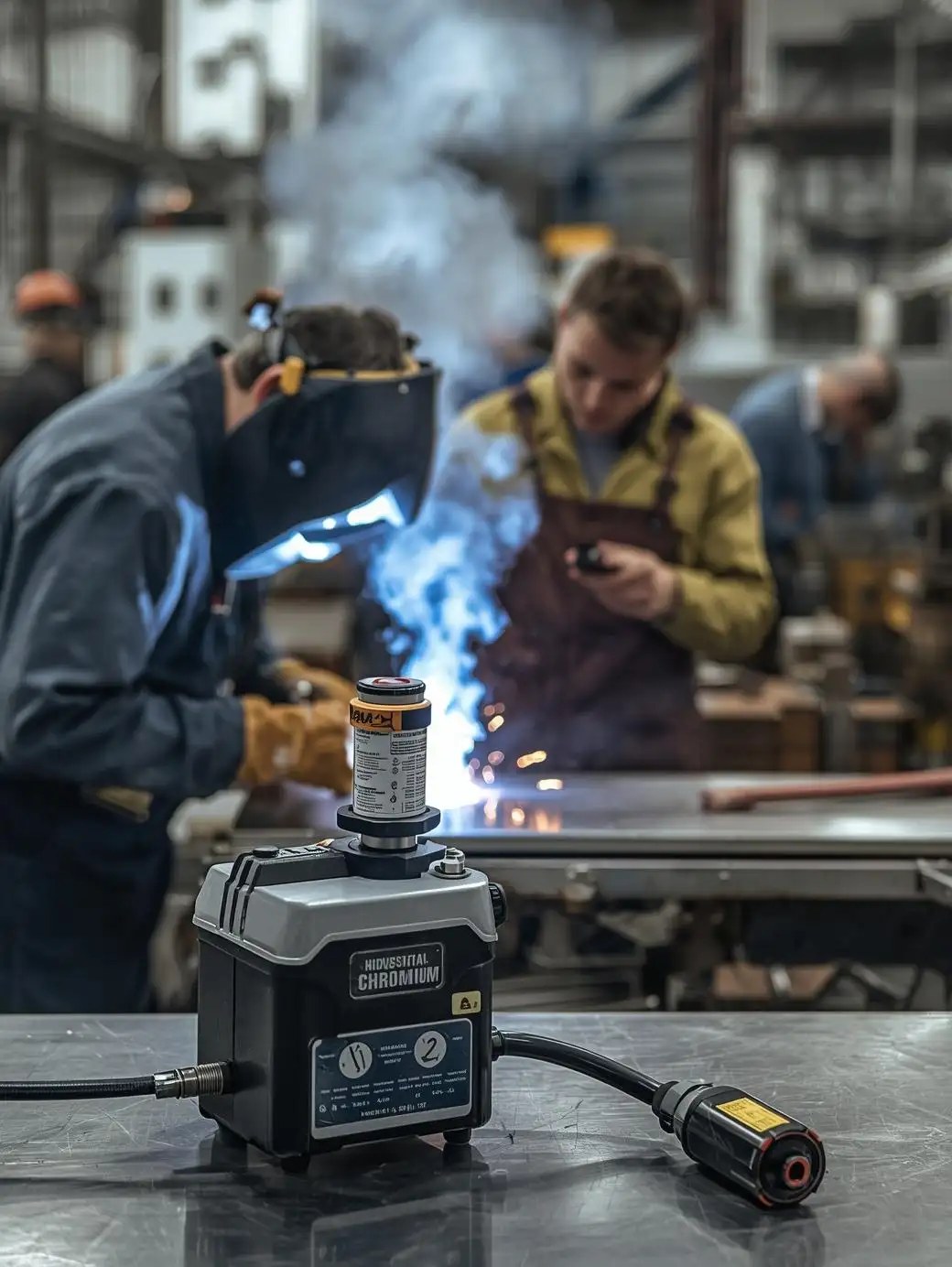
From Stainless Steel Welding Fume to Chrome Plating Mist — Three Sample Types in One Accredited Lab
AGT Labs performs all three hexavalent chromium testing categories from a single AIHA IHLAP-accredited Houston facility — personal breathing-zone air monitoring (OSHA ID-215 v2), surface wipe sampling (NIOSH 9102), and bulk coating analysis (alkaline extraction IC). Every report includes comparison to OSHA action level, OSHA PEL, and NIOSH REL. Cr(VI) speciation is one of the most analytically demanding services an IH testing lab performs — requiring refrigerated chain of custody, PVC filters with Na₂CO₃ pretreatment, and rapid extraction to prevent sample degradation.
- Personal breathing-zone hexavalent chromium testing — OSHA ID-215 (v2) IC, Na₂CO₃ PVC filter
- Short-term exposure (STEL) sampling during peak-exposure tasks — grinding, cutting, plating operations
- Area monitoring at welding stations, plating bath rims, ventilation exhausts
- Cr(VI) wipe sampling — work surfaces, equipment, hygiene areas (NIOSH 9102)
- Bulk chromate primer and coating analysis — zinc chromate, strontium chromate by alkaline IC
- Post-engineering-control verification — quantify LEV effectiveness at Cr(VI) welding operations
- Federal & DoD project support — AIHA IHLAP + ISO/IEC 17025 quality system
Where Operations Require Hexavalent Chromium Testing
Stainless Steel Welding & Thermal Cutting
The most common industrial Cr(VI) exposure source. When stainless steel (304, 316, 317, 321, 310 series containing 10–26% chromium) is arc welded, the high-temperature welding arc oxidizes Cr(III) in the base metal to Cr(VI) fume. SMAW, FCAW, GMAW, GTAW, and plasma cutting on stainless steel all generate Cr(VI) — concentrations in the breathing zone frequently exceed the OSHA PEL (5 µg/m³) without LEV.
Chrome Electroplating — Hexavalent Chrome Bath
Hard chrome and decorative chrome plating uses chromic acid (CrO₃) dissolved in water — a concentrated Cr(VI) solution. During electroplating, electrical current generates a fine chromic acid mist from the bath surface. Without fume suppressants or local exhaust ventilation at the bath rim, operators are directly exposed to Cr(VI) mist at concentrations typically well above the OSHA PEL.
Chromate Primer & Coating Disturbance
Zinc chromate, strontium chromate, and barium chromate pigments are used in corrosion-inhibiting primers on bridges, aircraft, marine vessels, industrial equipment, and railcars. Abrasive blasting, grinding, sanding, or mechanical disturbance of these coatings releases Cr(VI)-containing dust. Coating identification (bulk chip analysis) is required before disturbance.
Aerospace & Defense Coating Manufacturing
Aerospace manufacturing, military equipment maintenance, and aviation MRO facilities use chromate conversion coatings (chromic acid anodizing, Alodine, Iridite) and chromate primer extensively. Spray application of Cr(VI)-containing primers generates respirable chromate aerosol in the breathing zone of paint booth operators.
Chromate Pigment Manufacturing
Production of lead chromate (chrome yellow), zinc chromate, and other chromate pigments for industrial paints involves handling concentrated Cr(VI) compounds in powder and slurry form. Dust generation during charging, blending, drying, and packaging creates high-concentration Cr(VI) aerosol. Historically, chromate pigment workers have some of the highest documented occupational lung cancer rates.
Cement Manufacturing & Portland Cement Use
Portland cement contains water-soluble Cr(VI) — predominantly from chromite ore in raw materials. Workers handling cement (concrete finishing, masonry, cement manufacturing) are exposed to soluble Cr(VI) via both inhalation and dermal contact. Cement Cr(VI) is associated with occupational contact dermatitis ("cement eczema") and sensitization in addition to inhalation risk. Welding shops generating Cr(VI) fume should pair hexavalent chromium analysis with a comprehensive welding fume test covering manganese, nickel, cadmium, and other regulated metal constituents in the plume.
Hexavalent Chromium Testing for Surfaces — OSHA 1910.1026 Housekeeping Compliance
OSHA 1910.1026(j) requires housekeeping practices that minimize Cr(VI) surface contamination. Wipe sampling quantifies Cr(VI) surface loading on work surfaces, equipment, and hygiene areas — providing defensible documentation that housekeeping controls are effective.
Cr(VI) Wipe Sampling — NIOSH 9102
Surface wipe sampling for Cr(VI) uses pre-moistened wipe cloths collected from defined surface areas (100 cm²). Wipes are extracted in phosphate buffer and analyzed by IC for Cr(VI) specifically. Results in µg/100 cm² or µg/ft².
- Work surface and bench top sampling — quantify Cr(VI) dust deposition from welding or grinding operations
- Hygiene area sampling — cafeteria tables, locker room surfaces, change room floors — critical for preventing ingestion exposure
- Equipment surface contamination — tool handles, valve controls, shared equipment in Cr(VI) work areas
- Pre/post-housekeeping comparison — validate that vacuum + wet-wipe protocols achieve acceptable surface levels
- Post-renovation clearance — verify Cr(VI) surface contamination below hazard levels before re-occupancy
Cr(VI) Housekeeping Reference Levels
| Surface / Location | OSHA Requirement | Guidance Level |
|---|---|---|
| Work surfaces (bench, table) | As free as practicable | OSHA 1910.1026(j) |
| Eating / break area surfaces | Prohibit Cr(VI) — surfaces must be clean | No eating in Cr(VI) areas |
| Change room / locker surfaces | No contamination | OSHA 1910.1026(i) |
| Floors — general work area | Vacuum + wet-wipe; NO dry sweeping | 1910.1026(j)(1) |
| Ventilation duct surfaces | Periodic cleaning required | 1910.1026(j)(2) |
* OSHA 1910.1026 does not establish numeric surface clearance limits — requirements are qualitative ("as free as practicable"). Wipe sampling provides the quantitative baseline and trending data to demonstrate compliance and continuous improvement.
Turnaround Times & Sampling Kits — Refrigerated Chain of Custody
Hexavalent Chromium Testing Kit — Provided Free
- Na₂CO₃ / NaOH-impregnated 5 µm PVC filters (37mm, 3-piece cassette) — OSHA ID-215 (v2)
- Calibrated personal sampling pumps, 1–4 L/min (loaner) with post-calibration check sheet
- Ice packs and insulated shipping bag for refrigerated return COC
- Pre-moistened Cr(VI) wipe cloths + collection templates (100 cm²)
- Sample containers for bulk coating chips with pre-tare mass
- Chain-of-custody forms — includes temperature log and refrigeration confirmation section
- AGT Labs return shipping label (overnight configured)
Hexavalent Chromium Testing — From Filter to Certified Compliance Report
Identify Cr(VI) Operations
Stainless steel welding, chrome plating, chromate coating disturbance, or cement work? Confirm Cr(VI) is the target — not total chromium. Request OSHA ID-215 (v2) Na₂CO₃ filter kit from AGT Labs.
Deploy Na₂CO₃ Filter
Clip Na₂CO₃-impregnated PVC cassette to collar within 25 cm of nose. Set pump to 1–4 L/min. Record start time, task, process, ventilation status. Full-shift and STEL samples as required.
Seal & Ship to IH Lab
Upon sampling completion, seal filter cassette caps immediately. Place in evidence bag. Refrigerate at 4°C within 1 hour of collection. Arrange overnight shipping on ice packs — do not ship ambient.
IC or UV-Vis Analysis
Phosphate buffer extraction preserves Cr(VI) speciation. IC separation quantifies chromate ion specifically. UV-Vis DPC colorimetry as alternative/confirmation. All in-house at AGT Labs Houston.
Compliance Report Delivered
Results in µg/m³ vs. OSHA AL (2.5), OSHA PEL (5), NIOSH REL (0.2) — all three limits on every report. Compliance determination, OSHA 1910.1026 program trigger assessment. AIHA IHLAP number on report.
Who Relies on AGT Labs for Hexavalent Chromium Testing
Petrochemical Construction & Stainless Steel Fabrication
Houston's Gulf Coast petrochemical complex — refineries, chemical plants, LNG facilities — uses extensive stainless steel piping, vessels, and heat exchangers requiring continuous welding and maintenance. Stainless steel pipe welders are among the highest-risk occupations for Cr(VI) fume exposure. AGT Labs provides project-based and annual compliance monitoring programs for plant turnarounds, new construction, and maintenance work.
Metal Finishing & Hard Chrome Plating
Hard chrome electroplating for industrial tooling, hydraulic cylinders, and automotive components uses concentrated chromic acid (CrO₃) baths — the highest-concentration soluble Cr(VI) exposure in industry. OSHA 1910.1026 compliance requires continuous exposure monitoring, fume suppressant verification, LEV performance testing, and medical surveillance for all plating operators in metal fabrication and finishing shops.
Aerospace, Defense & Aviation MRO
Chromate conversion coatings (Alodine, chromic acid anodizing), zinc chromate primers, and strontium chromate topcoats are extensively used in military aircraft, commercial aviation, and defense equipment. Spray painters, coating applicators, and maintenance technicians performing sanding or stripping of chromate coatings require Cr(VI) monitoring.
Bridge & Infrastructure Coating Contractors
Texas DOT bridge repainting and industrial structure painting projects frequently encounter chromate-based corrosion inhibiting primers (zinc chromate) on older steel structures. Abrasive blasting of chromate primer releases Cr(VI) dust at high concentrations. Contractors must identify coating Cr(VI) content before work begins (bulk chip analysis) and conduct OSHA ID-215 (v2) air monitoring throughout blast operations.
Shipbuilding & Marine Maintenance
Commercial and naval vessels use chromate primers extensively for corrosion protection in shipyard and marine environments. Enclosed shipyard compartments and ship tanks create high-concentration Cr(VI) exposure during abrasive blasting, power tool cleaning, and recoating operations. Confined space entry in Cr(VI)-contaminated compartments requires both Cr(VI) and oxygen-deficiency monitoring.
IH Consultants & Industrial Hygiene Programs
Multi-client Cr(VI) monitoring programs across welding, plating, and coating industries. AGT Labs provides Na₂CO₃ filter kits with pre-configured overnight return shipping on ice, OSHA ID-215 (v2) IC analysis, and compliance reports against OSHA action level, PEL, and NIOSH REL — all three limits on every report. AIHA IHLAP accreditation number and clear compliance determination on every result. Aerospace and surface coating facilities that perform chromate spray operations may also require solvents and acid mist testing to evaluate solvent vehicle and acid aerosol exposures during the coating process.
Federal & DoD Facilities
Military aircraft maintenance (chromate conversion coatings on airframe skin), navy vessel refit (chromate primers on hull steel), federal facility decommissioning, ammunition plant operations, and aerospace MRO contracts require accredited Cr(VI) data. Our AIHA IHLAP accreditation (LAP-101470) and ISO/IEC 17025:2017 quality system support federal procurement and BRAC site remediation under TSCA, CERCLA, and DoD environmental data quality requirements.
Hexavalent Chromium Testing — FAQ
What is the OSHA PEL for hexavalent chromium?
Why can't NIOSH 7300 be used for hexavalent chromium compliance?
Why must hexavalent chromium samples be refrigerated?
Does stainless steel welding generate Cr(VI)?
What media is used for Cr(VI) air sampling?
What is the OSHA medical surveillance requirement for Cr(VI)?
What are chromate primers and how are they identified?
Can Cr(VI) and total chromium be tested from the same filter?
Is AGT Labs accredited for hexavalent chromium testing?
What is the difference between the OSHA Action Level and PEL for Cr(VI)?
What is the difference between soluble and insoluble Cr(VI) compounds?
What are the detection limits for OSHA ID-215 v2 Cr(VI) testing?
How long are Cr(VI) samples stable in shipping?
Does AGT Labs perform Cr(VI) testing for federal projects and DoD facilities?
Hexavalent Chromium Testing Lab Serving Houston's Industrial Base
AGT Labs is located at 10200 East Freeway, Suite 101, Houston TX 77029 — within the Houston Ship Channel industrial corridor. All OSHA ID-215 (v2) IC, UV-Vis, and alkaline digest Cr(VI) analysis is performed in-house. No send-outs. Samples received before 2:00 PM CST logged same day.
Accredited
8-hr TWA Limit
Emergency Cr(VI)
10200 E. Freeway
Need an Accredited IH Lab for Hexavalent Chromium Testing?
AIHA IHLAP (LAP-101470) · ISO/IEC 17025:2017 · OSHA ID-215 (v2) IC · Refrigerated COC Kits · 3-Limit Compliance Reporting · Houston TX 77029