
PAH Testing Lab Houston, TX — Polynuclear Aromatic Hydrocarbons · NIOSH 5506
Houston's AIHA IHLAP-accredited polynuclear aromatic hydrocarbons testing lab at 10200 East Freeway, Suite 101, Houston TX 77029 — continuously accredited since February 2000. NIOSH 5506 analysis for 17 individual PAH compounds by HPLC/UV at 254 nm — including benzo[a]pyrene, naphthalene, anthracene, pyrene, fluoranthene, and chrysene. AIHA LAP-101470 · NVLAP 101793-0. Coal tar pitch, roofing, coke ovens, foundries, asphalt paving, creosote, and Houston Ship Channel petrochemical exposure monitoring. Samples received before 2:00 PM CST logged same day. Rush 24-hour turnaround available.
Why accredited PAH analysis protects your workers
IARC Group 1 Carcinogen (BaP)
Benzo[a]pyrene is classified by IARC as a Group 1 confirmed human carcinogen — the highest classification. Several other PAHs are Group 2A (probable) or 2B (possible) carcinogens. Accredited IH lab testing with NIOSH 5506 documents exposure to this complex carcinogenic mixture.
Extremely Low Exposure Limits
The ACGIH TLV for benzo[a]pyrene is 0.1 µg/m³ — among the lowest occupational exposure limits for any chemical substance. OSHA's coal tar pitch volatile PEL is 0.2 mg/m³. IH testing is essential to detect exposures at these trace levels.
Multi-Route Exposure Risk
PAH exposure occurs through both inhalation and dermal absorption. Workers handling coal tar products, creosote, or working near combustion sources absorb PAHs through skin contact in addition to breathing contaminated air. Comprehensive monitoring captures both exposure routes.
Complex Mixture Carcinogenicity
Real-world PAH exposures involve complex mixtures of 17+ compounds with additive and potentially synergistic carcinogenic effects. NIOSH 5506 speciation identifies individual PAH compounds for complete risk characterization and defensible exposure records from an AIHA IHLAP-accredited lab (LAP-101470, accredited since 2000).
What Is PAH Exposure Testing?
PAH testing — formally known as polynuclear aromatic hydrocarbons testing — is an industrial hygiene (IH) air monitoring service that measures worker exposure to PAH compounds in workplace air using HPLC/UV analysis. Polynuclear aromatic hydrocarbons are a class of multi-ring organic compounds formed during incomplete combustion of organic materials. PAHs are ubiquitous in coal tar, creosote, coke oven emissions, diesel exhaust, and many industrial combustion processes. Because PAHs include confirmed human carcinogens like benzo[a]pyrene, accredited industrial hygiene testing is critical for workplace safety compliance.
As Houston's AIHA IHLAP-accredited PAH testing lab and trusted IH testing lab, AGT Labs performs all NIOSH 5506 analyses in-house by HPLC/UV at our Houston facility (LAP-101470, continuously accredited since February 2000). Our method quantitates up to 17 individual PAH compounds from a single air sample, capturing both particulate-phase (PTFE filter) and vapor-phase (XAD-2 sorbent) PAHs. No outsourcing, no subcontracting.
- Personal breathing zone PAH monitoring — NIOSH 5506 HPLC/UV
- Dual-phase sampling: PTFE filter (particulate PAHs) + XAD-2 sorbent (vapor PAHs)
- Individual quantitation of 17 PAH compounds including benzo[a]pyrene
- Coal tar pitch volatile (CTPV) monitoring for OSHA PEL compliance
- Benzo[a]pyrene-specific analysis against ACGIH TLV (0.1 µg/m³)
- Area monitoring at coke ovens, roofing sites, and foundry operations
- PAH speciation for carcinogenic risk assessment and exposure profiling
- OSHA 29 CFR 1910.1029 coke oven worker compliance support
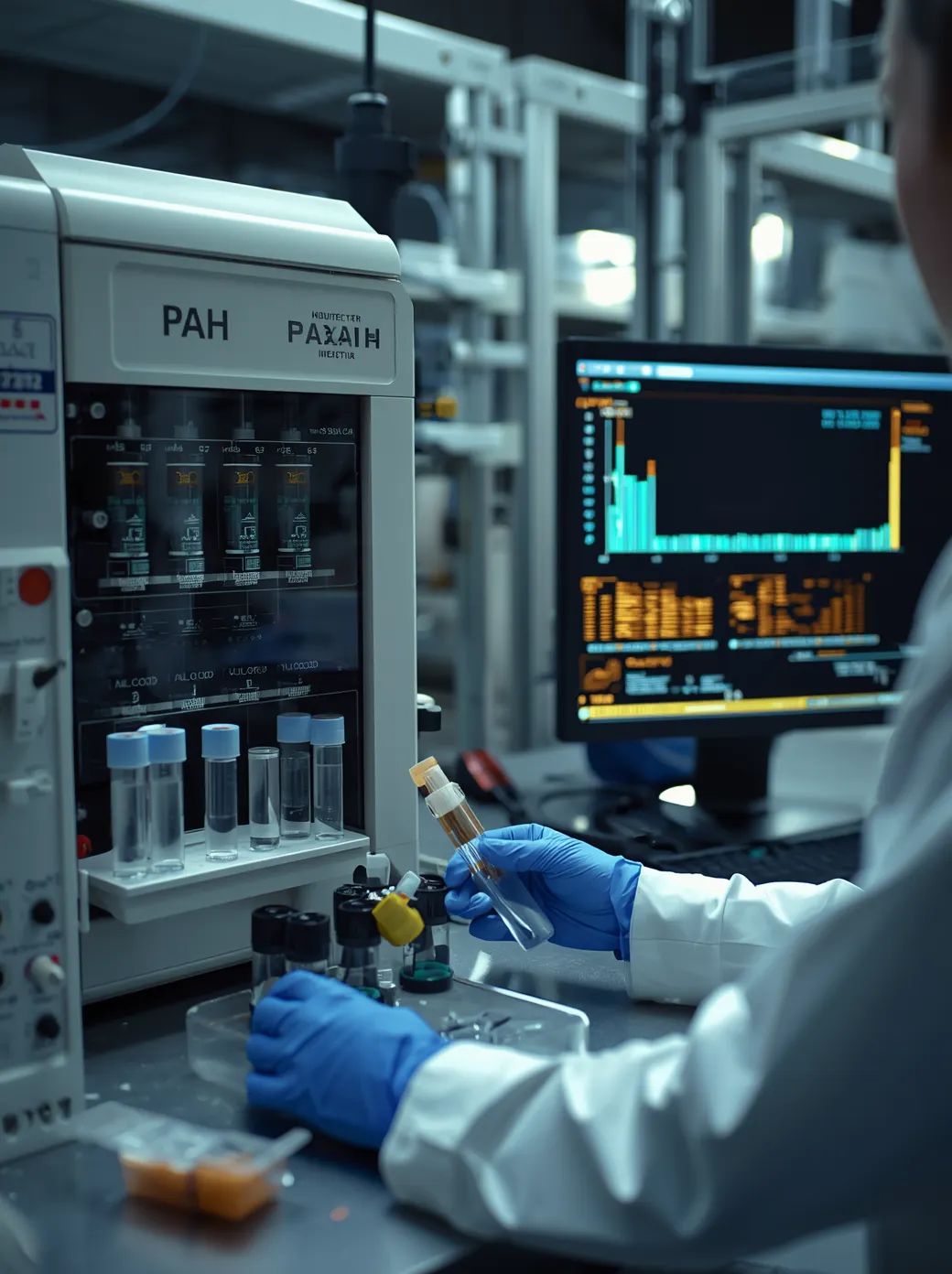
PAH Testing Method — NIOSH 5506
NIOSH 5506 is the validated analytical method for PAH compounds in workplace air. Here's exactly what this method measures, with detection limits and recommended sample volumes.
NIOSH 5506 — PAHs by HPLC/UV
Air is drawn through a two-stage sampling train: a PTFE filter captures particulate-phase PAHs, backed by an XAD-2 sorbent tube that traps vapor-phase PAHs. Both stages are extracted with acetonitrile and analyzed by HPLC with UV detection at 254 nm. Quantitates up to 17 individual PAH compounds including benzo[a]pyrene, naphthalene, anthracene, pyrene, fluoranthene, chrysene, and benz[a]anthracene.
Detection Limits, Sample Volumes & Quantification
Sample volume drives detection capability. The longer you sample, the lower the air concentration you can quantify. Use this guidance to design your sampling plan around the OSHA CTPV PEL (0.2 mg/m³) and the ACGIH BaP TLV (0.1 µg/m³).
| Sampling Scenario | Flow / Time | Total Volume | Reportable Range — BaP (NIOSH 5506) | Best for |
|---|---|---|---|---|
| Short-task sample (1-hr) | 2.0 L/min × 60 min | 120 L | ~2.5 µg/m³ – Total CTPV PEL | Coal tar kettle work, brief tasks, pour events |
| Half-shift TWA | 2.0 L/min × 4 hr | 480 L | ~0.6 µg/m³ – CTPV PEL | Half-shift personal monitoring, segmented work |
| Full-shift TWA (8-hr) | 2.0 L/min × 8 hr | 960 L | ~0.3 µg/m³ – CTPV PEL | OSHA 8-hr TWA — CTPV PEL (0.2 mg/m³) compliance |
| BaP-targeted (16-hr) | 2.0 L/min × 16 hr (composite) | 1,920 L | ~0.15 µg/m³ – ACGIH BaP TLV range | BaP-specific monitoring near 0.1 µg/m³ TLV |
| Environmental / IAQ | 4.0 L/min × 24 hr | 5,760 L | down to ~0.05 µg/m³ | Brownfield assessment, MGP site work, ambient |
Reading the math: Reportable range = LOQ (~0.3 µg per compound) ÷ sample volume (L), converted to µg/m³. A 960-L full-shift sample resolves to ~0.3 µg/m³ for BaP — sufficient for OSHA CTPV PEL compliance documentation. For BaP-specific monitoring at the ACGIH TLV of 0.1 µg/m³, longer composite sampling or higher flow rates are required. Detection limits vary by individual PAH compound based on UV absorption efficiency at 254 nm — high-MW PAHs like benzo[a]pyrene generally have lower LOD than naphthalene. Talk to our IHLAP-accredited analysts at (713) 453-6090 for project-specific detection limit guidance.
17 EPA Priority PAH Compounds
NIOSH 5506 quantitates the following 17 individual PAH compounds. Each has a different carcinogenic potency, as reflected in the IARC classification system.
| # | Compound | Rings | IARC Group | Note |
|---|---|---|---|---|
| 1 | Naphthalene | 2 | 2B (possible) | Lightest PAH; primarily vapor-phase; mothball odor |
| 2 | Acenaphthylene | 3 | 3 (not classifiable) | Combustion product; environmental marker |
| 3 | Acenaphthene | 3 | 3 | Coal tar constituent; creosote component |
| 4 | Fluorene | 3 | 3 | Coal tar and petroleum product |
| 5 | Phenanthrene | 3 | 3 | Most abundant PAH in most environmental samples |
| 6 | Anthracene | 3 | 3 | Used in dye manufacturing; coal tar component |
| 7 | Fluoranthene | 4 | 3 | Common combustion PAH; used in TEF calculations |
| 8 | Pyrene | 4 | 3 | Urinary 1-OHP metabolite used as biomarker |
| 9 | Benz[a]anthracene | 4 | 2B (possible) | Carcinogenic PAH; coal tar marker |
| 10 | Chrysene | 4 | 2B (possible) | Common in coal tar and diesel exhaust |
| 11 | Benzo[b]fluoranthene | 5 | 2B (possible) | Carcinogenic; combustion product |
| 12 | Benzo[k]fluoranthene | 5 | 2B (possible) | Carcinogenic; lower abundance than BbF |
| 13 | Benzo[a]pyrene (BaP) | 5 | Group 1 | Primary carcinogenic marker; TEF reference compound |
| 14 | Indeno[1,2,3-cd]pyrene | 6 | 2B (possible) | High-molecular-weight PAH; particulate-phase |
| 15 | Dibenz[a,h]anthracene | 5 | Group 2A | Probable carcinogen; high TEF value |
| 16 | Benzo[ghi]perylene | 6 | 3 | Automotive exhaust marker compound |
| 17 | Benzo[e]pyrene | 5 | 3 | Isomer of BaP; lower carcinogenic potency |
Benzo[a]pyrene — The Carcinogenic Marker Compound
Among the 17 PAH compounds measured by NIOSH 5506, benzo[a]pyrene (BaP) holds unique significance in occupational and environmental health. It is the only PAH classified by IARC as a Group 1 confirmed human carcinogen — the same classification level as asbestos and benzene.
BaP serves as the reference compound for PAH mixture cancer risk assessment. The Toxic Equivalency Factor (TEF) system assigns each PAH a potency factor relative to BaP (TEF = 1.0). By multiplying each PAH concentration by its TEF and summing the results, industrial hygienists can calculate a BaP-equivalent concentration that represents the overall carcinogenic potency of a complex PAH mixture.
- IARC Classification: Group 1 — confirmed human carcinogen (sufficient evidence in humans)
- ACGIH TLV: 0.1 µg/m³ — among the lowest occupational exposure limits for any chemical
- TEF Reference: BaP = 1.0; all other PAH potencies expressed relative to BaP
- Cancer Types: Lung cancer, skin cancer, and bladder cancer associated with occupational BaP exposure
- Metabolic Activation: BaP is metabolized to diol-epoxide intermediates that bind directly to DNA, initiating carcinogenesis
- Analytical Sensitivity: NIOSH 5506 HPLC/UV provides individual BaP quantitation at sub-µg/m³ concentrations
![Benzo[a]pyrene BaP IARC Group 1 carcinogen marker compound NIOSH 5506](https://industrialhygiene.agtlabs.com/wp-content/uploads/2026/04/benzopyrene-marker-compound.webp)
Coal Tar Pitch Volatiles (CTPV) vs Individual PAH Analysis
There are two fundamentally different approaches to measuring PAH exposure in the workplace. Understanding the difference is critical for choosing the right analytical strategy for your project.
OSHA CTPV Method (Benzene-Soluble Fraction)
The traditional OSHA approach measures total coal tar pitch volatiles as a benzene-soluble fraction — a gravimetric method that weighs everything extracted from the filter by benzene. OSHA PEL: 0.2 mg/m³. This method is simple but provides no information about which specific PAH compounds are present or their individual concentrations.
NIOSH 5506 Individual PAH Speciation (HPLC/UV)
The modern approach uses NIOSH 5506 HPLC/UV to identify and quantify 17 individual PAH compounds. This provides compound-specific data that supports TEF-based carcinogenic risk assessment, identifies exposure sources, and quantifies the most hazardous PAHs individually.
- Why NIOSH 5506 is preferred: Identifies specific carcinogenic compounds (BaP, dibenz[a,h]anthracene) individually
- Risk assessment: TEF calculations require individual compound data — CTPV total cannot support TEF analysis
- Source identification: PAH profiles differ between coal tar, diesel exhaust, and other combustion sources
- Regulatory trend: ACGIH TLV for BaP (0.1 µg/m³) drives individual compound monitoring
- When to use CTPV: OSHA compliance documentation specifically requiring benzene-soluble fraction measurement
- Best practice: Request both CTPV total and individual speciation for maximum regulatory and risk assessment coverage
NIOSH 5506 — Deliverables & Report Format
No surprises in your PAH testing report. Here's exactly what NIOSH 5506 IH testing analysis returns.
| Analysis Type | Method / Standard | Sample Media | Report Deliverable | Rush? |
|---|---|---|---|---|
| NIOSH 5506 — Filter (Particulate) | NIOSH 5506 · HPLC/UV | PTFE filter (37mm, 0.5µm) | 17 individual PAH concentrations (µg/m³) — particulate phase | Yes |
| NIOSH 5506 — XAD-2 (Vapor) | NIOSH 5506 · HPLC/UV | XAD-2 sorbent tube (100/50mg) | 17 individual PAH concentrations (µg/m³) — vapor phase | Yes |
| NIOSH 5506 — Combined Total | NIOSH 5506 · HPLC/UV | Filter + XAD-2 combined | Total PAH + individual speciation + BaP + CTPV comparison | Yes |
| CTPV Total (Benzene-Soluble) | OSHA CTPV gravimetric | PTFE filter (37mm) | Total CTPV (mg/m³) for OSHA PEL comparison | Limited |
Turnaround Times & Free Testing Kits
Every rush option and kit detail for PAH testing — clearly laid out before you submit your first sample to our IH testing lab.
PAH Monitoring Isn't One-and-Done
OSHA's coke oven standard (29 CFR 1910.1029) requires periodic exposure monitoring, and coal tar, roofing, and remediation projects run in phases that each change the exposure profile. Set up a recurring program and we'll schedule your rounds, supply pre-assembled NIOSH 5506 sampling trains, and apply standing-account volume pricing.
Free PAH Testing Kit Includes
- PTFE membrane filters (37mm, 0.5µm pore) in cassettes — lot-certified
- XAD-2 sorbent tubes (100mg/50mg) — pre-cleaned, sealed
- Cassette-to-tube connection tubing (Tygon)
- Field blank filters and sorbent tubes (10% QA compliance)
- Pre-paid UPS return shipping label (domestic)
- PAH Chain of Custody (COC) form — pre-numbered
- Calibrated personal sampling pump (rental available)
- Light-tight storage bags for sample protection
Kits ship via UPS Ground — order with 5 business days notice. Houston metro courier pickup available: (713) 453-6090.
Sampling Field Requirements
Incorrect sampling invalidates PAH testing results and wastes project time. Follow these parameters to ensure every sample produces valid, defensible data.
PAH Testing: From Sample Collection to Certified Report
Request Kit or COC
Call, email, or request PAH testing COC. PTFE filters, XAD-2 tubes, and sampling pumps ship free with 5 days notice.
Collect Samples
Assemble dual-stage sampling train per NIOSH 5506. Sample at 2 L/min during coal tar, coke oven, or foundry operations. Record flow rates on COC.
Ship to IH Lab
Ship via UPS. Keep samples cool and protected from light. PAH samples logged same day if received before 2:00 PM CST.
HPLC/UV Analysis at IH Lab
HPLC with UV detection analysis of both filter and XAD-2 fractions at our Houston IH testing facility. 17-compound speciation plus combined totals. No outsourcing.
Certified PAH Report
Results delivered with individual PAH concentrations, BaP-specific data, CTPV total, OSHA PEL comparison, analyst signature, QA sign-off, and AIHA LAP-101470 accreditation.
Standards That Require Accredited Testing
Every AGT Labs PAH testing report from our IH lab is structured to satisfy all applicable federal and Texas state regulatory requirements.
Who Relies on Our Lab for PAH Testing
Coal Tar Roofing & Waterproofing
Hot coal tar built-up roofing (BUR) and waterproofing membrane application generates concentrated PAH fumes. Workers applying, heating, and handling coal tar pitch on construction sites face the highest occupational PAH exposures. NIOSH 5506 personal monitoring during application is essential.
Coke Oven & Steel Production
Coke oven topside workers, larry car operators, and door machine operators face extremely high PAH exposures from coal tar pitch volatiles. OSHA 29 CFR 1910.1029 requires specific exposure monitoring, medical surveillance, and regulated area controls for coke oven workers.
Aluminum Smelting
Söderberg process aluminum smelting uses carbon anodes containing coal tar pitch binder — releasing PAH fumes into pot room environments. Workers face significant inhalation and dermal PAH exposure. NIOSH 5506 monitoring with BaP speciation required.
Creosote Wood Treatment
Creosote-treated lumber production and handling exposes workers to complex PAH mixtures through both inhalation and skin contact. Railroad tie treatment, utility pole manufacturing, and marine piling operations require comprehensive PAH monitoring.
Asphalt Paving
Hot mix asphalt (HMA) paving operations generate PAH-containing fumes, especially at high application temperatures. While asphalt PAH content is lower than coal tar, continuous full-shift monitoring with NIOSH 5506 documents worker exposure.
Foundry Operations
Sand core binders and metal pouring operations release PAHs from thermal decomposition of organic binder materials. Pouring floor workers and core room operators face PAH exposure during active production. IH lab monitoring per NIOSH 5506 required.
Refineries & Power Plants
Houston Ship Channel refinery coker units, biomass combustion facilities, and waste incineration operations generate PAH-containing particulate and vapor emissions. Stack and ambient air monitoring combined with personal exposure assessment provides complete data.
Government & Federal Facilities
Public building renovation, environmental remediation, and former manufactured gas plant (MGP) site cleanups require accredited laboratory analysis of worker PAH exposure. AGT Labs' AIHA IHLAP accreditation (LAP-101470) and ISO/IEC 17025:2017 quality system support PAH monitoring on these projects. Note that environmental analysis on DoD and DOE installations is separately governed by DoD-ELAP requirements — contact us to confirm scope before bidding.
Frequently Asked Questions
Common PAH testing questions answered by our IHLAP-accredited IH lab analysts.
What is NIOSH 5506 and how does it measure PAH exposure?
What is the OSHA PEL for coal tar pitch volatiles?
Which industries require PAH exposure monitoring?
Why is benzo[a]pyrene the most important PAH to monitor?
What sampling media do I need for PAH air monitoring?
How long does PAH testing take at AGT Labs?
Can AGT Labs analyze both particulate and vapor-phase PAHs?
What is the detection limit for NIOSH 5506 PAH analysis?
How long do PAH samples remain stable after collection?
Is AGT Labs accredited for PAH testing?
What is the difference between total CTPV and individual PAH speciation?
Can I order CTPV-only analysis without individual PAH speciation?
How much does PAH testing cost?
Can PAH exposure be monitored through biological samples?
What are the IARC classifications for common PAHs?
Does AGT Labs handle PAH testing for government and federal facility projects?
What industries have the highest PAH exposure levels?
PAH Testing Lab Serving Houston's Industries
AGT Labs is located at 10200 East Freeway, Suite 101, Houston TX 77029 — inside the Houston Ship Channel industrial corridor. As a full-service industrial hygiene testing lab, all NIOSH 5506 PAH analyses are performed in-house. No outsourcing, no send-outs. Samples received before 2:00 PM CST logged same day.
Accredited (Since 2000)
Compounds Analyzed
TAT Available
10200 E. Freeway
Need an Accredited IH Lab for PAH Testing?
AIHA IHLAP-accredited PAH testing lab since 2000 · LAP-101470 · NVLAP 101793-0 · NIOSH 5506 · 17 PAH compounds · Benzo[a]pyrene · HPLC/UV · Rush same-day available · 10200 East Freeway, Houston TX 77029. Ask about recurring monitoring programs and volume pricing for ongoing OSHA compliance sampling.