
Introduction
Mold and bioaerosols can impact occupant comfort, trigger allergies, and degrade building materials. A detailed investigation helps pinpoint moisture problems, hidden contamination, and air quality concerns. AGT Labs performs targeted assessments to ensure a safer, healthier indoor environment and provide clear guidance for remediation.
Mold & bioaerosol investigations help determine the presence, type, and extent of microbial contamination within indoor environments. Understanding these biological pollutants is essential for identifying moisture issues, evaluating occupant exposure risks, and planning corrective actions.
Purpose
Mold & Bioaerosol Testing plays a crucial role in identifying airborne and surface microbial contaminants such as fungal spores, yeasts, bacteria, and endotoxins. Our approach to mold & bioaerosol testing focuses on understanding microbial activity within indoor environments to support health risk evaluations and remediation plans.
Elevated fungal spores or viable bioaerosols can exacerbate asthma, allergic reactions, and respiratory irritation. Through structured mold & bioaerosol testing, AGT Labs helps determine contamination levels, define remediation scope, and verify whether corrective actions restored healthy indoor conditions.
Testing Overview
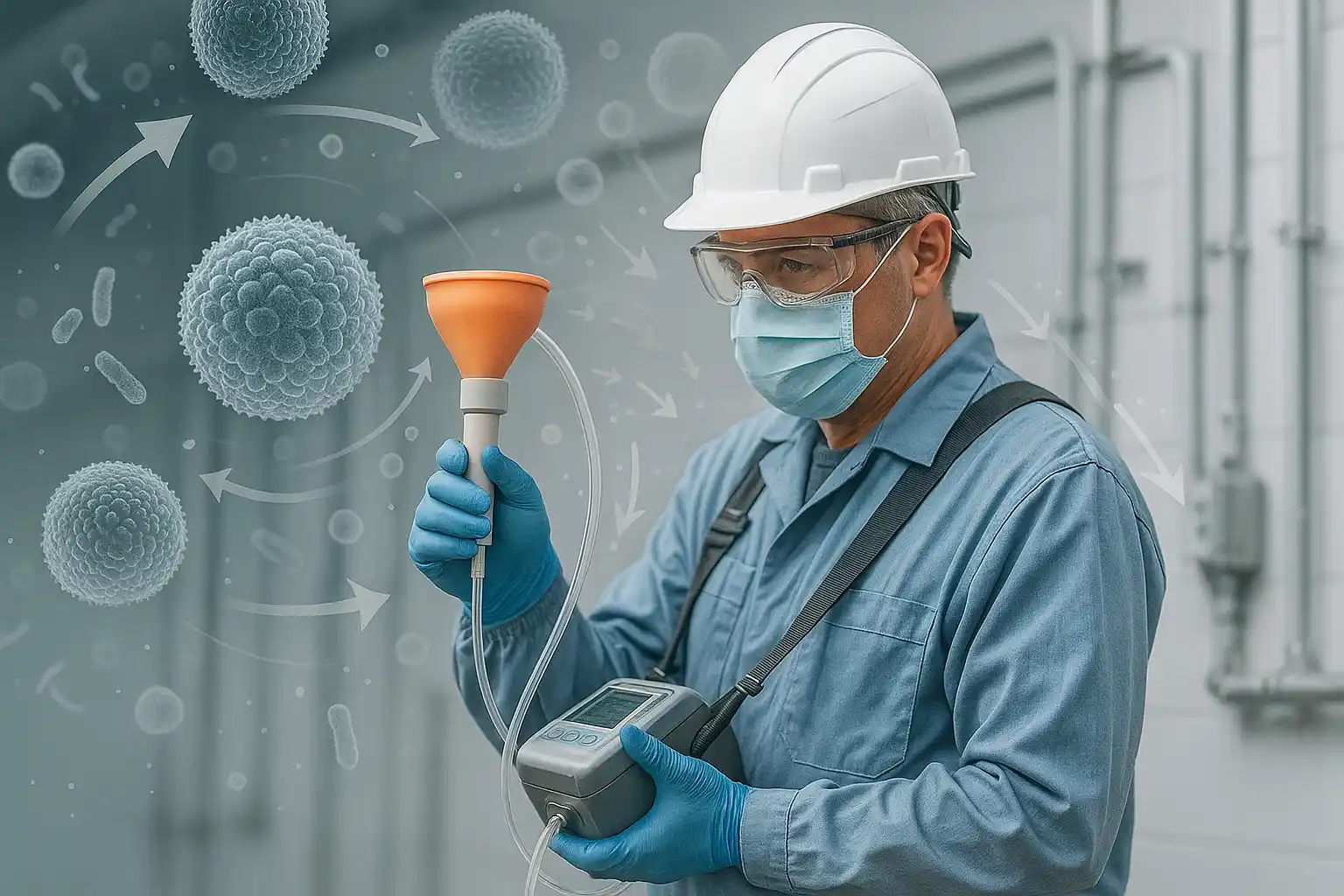
AGT Labs provides a full suite of mold & bioaerosol testing services using both qualitative and quantitative analytical methods. Our team uses non-viable air cassettes, viable impactors, liquid impingers, and molecular tools to capture a complete microbial profile of your environment.
Air sampling may involve spore trap cassettes (non-viable microscopy), Andersen/impactor samplers (viable CFU analysis), and liquid impingers for viability and molecular studies. Surface sampling—an essential part of mold & bioaerosol testing—uses sterile swabs, contact plates, or tape lifts to map contamination patterns and confirm remediation success.
Laboratory workflows include microscopic spore identification, culture-based enumeration, and qPCR panels targeting species such as Aspergillus, Stachybotrys, and Penicillium. All mold & bioaerosol testing is performed under a documented chain of custody and accredited QA/QC protocol.

Moisture Intrusion & Hidden Mold Reservoirs
Indoor mold and bioaerosol contamination often originates from hidden moisture sources such as leaks, condensation, poor ventilation, or failures in building envelopes. Microbial reservoirs may develop behind walls, under flooring, inside HVAC systems, or on water-damaged materials.
Detection challenges arise when contamination is concealed, intermittent airflow affects airborne counts, or levels fluctuate with HVAC cycling. Multiple sampling methods may be required for accurate assessment.
Testing Options
We offer several sampling approaches based on building conditions and suspected contamination.
Indoor / Outdoor Paired Air Sampling
Compare indoor vs. outdoor levels.
Viable (Culture) Sampling
CFU/m³ analysis using Andersen samplers.
Non-Viable Sampling
Spore trap microscopy using Air-O-Cell cassettes.
Surface Sampling
Swabs, tape-lifts, and contact plates.
qPCR Panels
Molecular detection for target mold species.
HVAC & Duct Testing
Identify microbial reservoirs in ventilation systems.
Sampling Media & Equipment Supply
AGT Labs supplies ready-to-use sampling kits with spore traps, Andersen plates, agar media, sterile swabs, vials, pumps, and impingers—complete with handling instructions and cold-chain options for viable media.
Sampling Guidelines
Follow these guidelines for accurate results:
- Collect indoor/outdoor paired samples.
- Use viable methods for species-level ID.
- Standard spore trap run: 5–10 minutes @ 15 L/min.
- Record humidity, HVAC status, and visible growth.
- Ship viable media cold (2–8°C).
- Include ≥10% field blanks and duplicates.
Airborne Spore Monitoring During Remediation
Monitoring airborne spores during remediation ensures containment integrity, verifies engineering controls, and tracks fluctuations in particulate levels caused by disturbance of mold-impacted materials.
Clearance sampling is performed after remediation to confirm that airborne spore levels and surface contamination have been reduced to acceptable levels before reoccupancy.
Accreditation & Standards
Our services comply with industry-recognized analytical and reporting standards.
Deliverables & Value-Added Services for Cr(VI) Testing
- Spore trap morphology results.
- Culture-based CFU/m³ with species ID.
- qPCR rapid detection.
- Surface sampling microscopy.
- Interpretive findings with remediation guidance.
- Clearance sampling verification.
- HVAC system hygiene analysis.
- Moisture intrusion mapping.
- Emergency and CIH support.
Summary
AGT Labs’ mold & bioaerosol testing program provides a comprehensive, science-driven evaluation using accredited analytical methods for remediation, occupant safety, and clearance documentation.
Turnaround: 3–5 business days (non-viable), 5–10 business days (culture/qPCR).
Contact AGT Labs
Reach out to our team for mold & bioaerosol testing support.
Email: info@agtlabs.com Call: +1 (713) 453-6090